
How Much Does It Cost to Start an Equipment Rental Business?
Estimate equipment rental startup costs with three example budgets, a cash-reserve worksheet, and the costs to check before your first rental.
October 20, 2026 · 10 min read
Key takeaways
The practical answer
- Build your startup budget from equipment, transport, premises, launch expenses, contingency, and cash needed while bookings grow.
- The worked examples total $32,650, $160,850, and $646,500. They are planning scenarios with explicit assumptions, not national averages or supplier quotes.
- Price the rental workflow as well as the fleet: software, payment costs, maintenance, customer handoffs, and staff time all need a place in the plan.
How much does it cost to start an equipment rental business? In the US-dollar examples below, a lean tool-rental setup needs about $33,000, a small rental yard about $161,000, and a larger construction-equipment operation about $647,000. These are illustrative budgets we constructed, not surveyed startup averages. Your total depends on the inventory you buy, assets you already have, location, delivery model, and cash needed before rentals cover expenses.
This guide is for prospective equipment, tool, and trailer rental operators. RentalBench publishes it to help you cost the operation and test the rental workflow. It separates verified public prices from example inputs; replace the inputs with local supplier, property, insurance, and professional-service quotes before committing money.
In this guide
- Three example startup budgets
- What belongs in the budget
- Cash purchases versus financing
- Working capital and break-even
- Where RentalBench fits
- A budget worksheet
- Startup cost FAQs
Three equipment rental business startup budgets
The following table shows chosen planning assumptions in USD, not market price ranges. All three scenarios buy equipment outright, lease or use existing space rather than buy property, and include three months of operating cash plus a contingency equal to 10% of pre-opening outlays. Neither three months nor 10% is a universal requirement.
| Budget line | Lean tool setup | Small rental yard | Larger construction fleet |
|---|---|---|---|
| Equipment acquisition allowance | $15,000 | $75,000 | $350,000 |
| Delivery vehicle and trailer acquisition | $0 | $18,000 | $65,000 |
| Storage or premises deposits and setup | $2,500 | $10,000 | $25,000 |
| Initial insurance, registration, and professional fees | $2,000 | $5,000 | $12,000 |
| Website setup and launch materials | $500 | $1,500 | $3,000 |
| Initial accessories, preparation, and service supplies | $1,500 | $4,000 | $10,000 |
| Pre-opening subtotal | $21,500 | $113,500 | $465,000 |
| Contingency: 10% of that subtotal | $2,150 | $11,350 | $46,500 |
| Three-month operating reserve | $9,000 | $36,000 | $135,000 |
| Illustrative starting cash | $32,650 | $160,850 | $646,500 |
The lean setup assumes usable storage already exists and customers collect equipment. Its $0 delivery-vehicle purchase does not mean handling or transport is free. The yard and construction examples assume progressively larger acquisition and operating allowances; the labels do not guarantee a particular number of machines.
Treat acquisition allowances as landed costs: purchase price, applicable purchase tax, freight, and commissioning. The reserve assumes monthly cash outgoings of $3,000, $12,000, and $45,000 respectively, including planned owner pay, staffing where applicable, and recurring operating expenses. These are model inputs, not wage or overhead benchmarks. Existing equipment or premises can reduce new cash required, while major site work or property purchase can push costs above these examples.
What costs should you include before opening?
The U.S. Small Business Administration's startup-cost guidance separates one-time expenses from monthly expenses. Apply that distinction to every quote so deposits, purchases, and ongoing bills do not disappear inside a single “fleet budget.”
Equipment and the accessories needed to rent it
Build a buying list by product and physical unit. Record condition, purchase price, freight, setup, spare parts, attachments, and the accessories customers need to use the equipment. A machine without the necessary accessory may consume capital without serving the intended job.
As one dated price reference, Honda listed the EU2200i generator at a $1,199 MSRP when checked on October 20, 2026. Four at that MSRP equal $4,796 before additional charges. This is a manufacturer price example, not a fleet recommendation or an all-in dealer quote. Use actual commercial-use suitability, warranty terms, and landed quotes for your buying list.
Used equipment needs its own inspection and preparation allowance. An attractive purchase price may leave repairs due before the first rental. Compare new and used options on the cost to put a dependable unit into service, not the advertisement alone.
Storage, security, pickup, and delivery
List lease deposits, fencing, locks, lighting, shelving, signage, utilities, and any setup work separately. A refundable deposit still ties up opening cash. If you already have space, check that the proposed activity, customer pickup, and storage arrangements are acceptable before assuming its incremental cost is zero.
For delivery, price the vehicle, trailer, loading equipment, restraints, fuel, servicing, and staff time. Confirm suitability and local requirements for the actual equipment and loads. A pickup-only model changes the budget; it does not remove the need for an orderly customer handoff.
Insurance, registration, and professional help
Ask an insurer to quote your rental activity, equipment, locations, delivery arrangements, and customer use. Ask what happens while equipment is off-site and which exclusions or deductibles matter. The SBA's insurance guidance recommends assessing risks and comparing terms with licensed agents; a general online premium cannot establish your coverage or price.
Obtain local registration, permit, accounting, and contract-review costs. Distinguish government fees from optional filing services. For example, the IRS issues employer identification numbers free of charge; a third party's service charge is a separate expense. Requirements and eligibility depend on your situation.
Software, website, and customer acquisition
Budget for the operating system, website setup, domain, payment processing, bookkeeping, communications, and launch marketing. Separate setup charges from recurring subscriptions and transaction fees. If a subscription already includes a storefront, compare its actual capabilities before paying for a separate booking system.
Also price your time: creating the catalog, cleaning an import, preparing terms, taking product photos, and testing rentals. A free spreadsheet can be a reasonable start, but manual work still belongs in the operating plan.
How financing changes the cash you need
Buying outright and financing the same machine produce different cash schedules. Keep the full equipment value in your asset plan, but put only the cash actually payable at launch into the opening-cash calculation.
For an illustrative $30,000 machine with a chosen 20% down-payment assumption, the deposit is $6,000 and the remaining $24,000 is financed. This arithmetic is not a loan offer. Fees, interest, term, approval, and payment timing require a lender quote.
Replace the $30,000 cash purchase with the $6,000 down payment and any upfront charges, then add the scheduled repayments to monthly outgoings. Do not count the full purchase and down payment as two opening payments. Do not ignore repayments when calculating the cash reserve.
Compare total repayments and obligations as well as launch cash. Financing may reduce the initial payment while increasing future commitments. Ask an accountant to distinguish cash flow, profit, depreciation, and tax treatment for your business.
How much working capital should you allow?
Build a monthly cash forecast, including a slower-than-expected launch. The three-month reserves above make the examples reproducible; they do not establish that three months will cover your needs. The SBA recommends projecting at least a year of monthly expenses in its startup-cost guidance. A projection horizon and the amount of cash you hold are different decisions.
Use this starting calculation for a no-revenue stress case:
operating reserve = monthly cash outgoings × months to cover
If the yard example needs six months rather than three, its reserve rises from $36,000 to $72,000. Its illustrated starting cash becomes $196,850. Change the revenue and collection assumptions month by month once you have evidence for them.
Check the rental volume the operation would need, too. Suppose monthly fixed cash commitments are $6,000, realized rental revenue is $80 per billable unit-day, and variable cash costs are $20 per unit-day. The simplified cash break-even is:
$6,000 ÷ ($80 − $20) = 100 billable unit-days per month
Those are example inputs across the fleet, not a demand forecast or profit promise. Include owner pay, debt payments, and other relevant cash commitments consistently, and separately plan equipment replacement and taxes. Use the equipment rental rate calculator to explore one item's pricing assumptions; it does not replace the whole-business cash forecast.
Where RentalBench fits in the startup budget
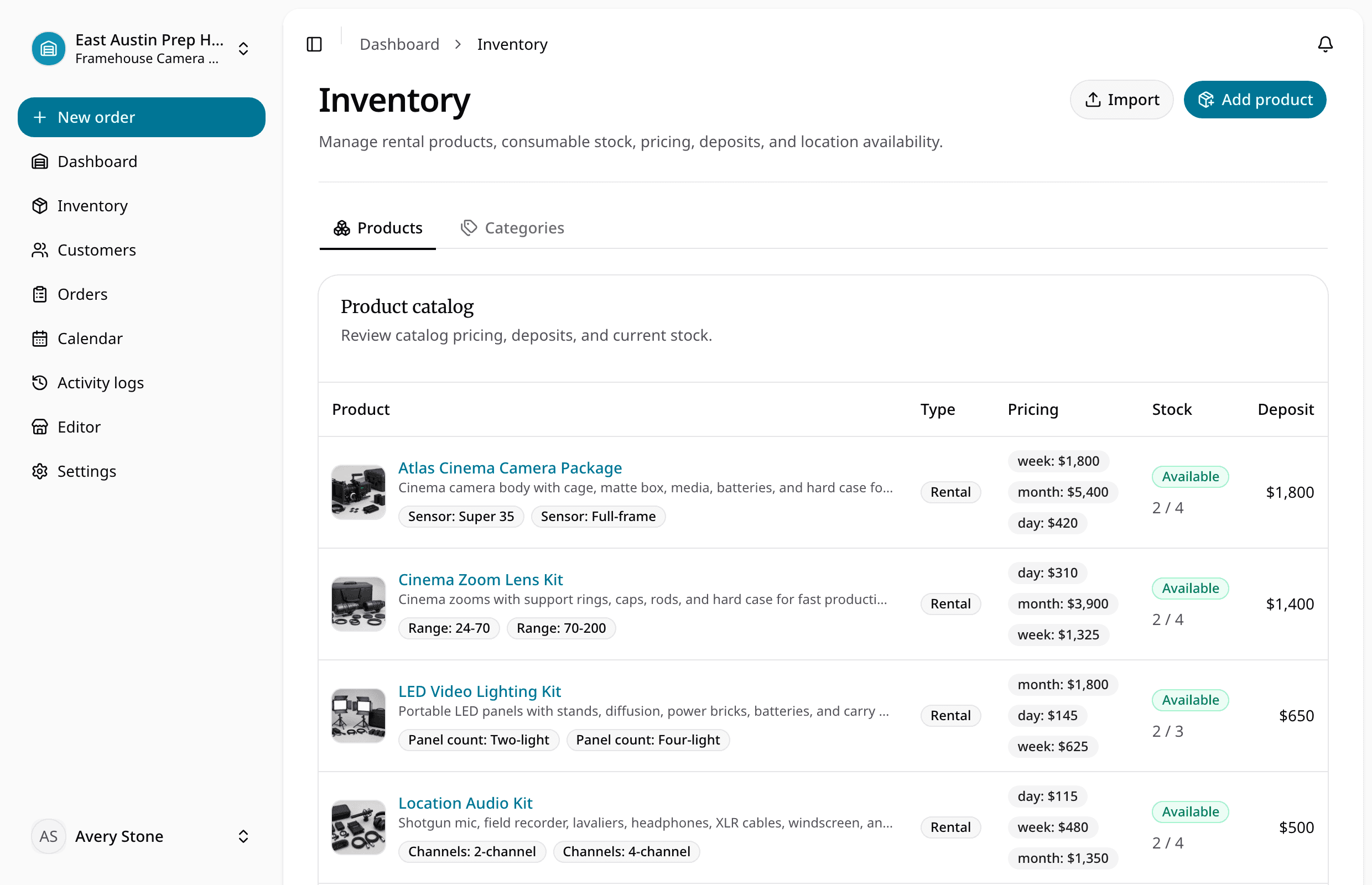
RentalBench helps organize the inventory and customer workflow after you define the business model. It connects equipment records, rates, deposits, availability, orders, checkout, and return inspection. It is not a startup-budget calculator, accounting ledger, financing service, or insurance policy.
The current RentalBench plans start at $29 per month for Start, covering one user and one location. Plus is $59 per month for up to five users at one location; Pro is $119 per month for up to 30 users and multiple locations. Those monthly-billing prices were checked October 20, 2026. Include the relevant subscription in monthly outgoings, with any applicable tax, payment fees, and separately charged services.
Try setting up your first rental inventory in RentalBench.
Before importing the full fleet, create two sample units with distinct IDs, set their rates and deposit requirements, reserve one for a customer, and follow checkout through return inspection. Test a damaged return as well as a normal one. Damaged rental units move into maintenance so they cannot satisfy new rental demand.
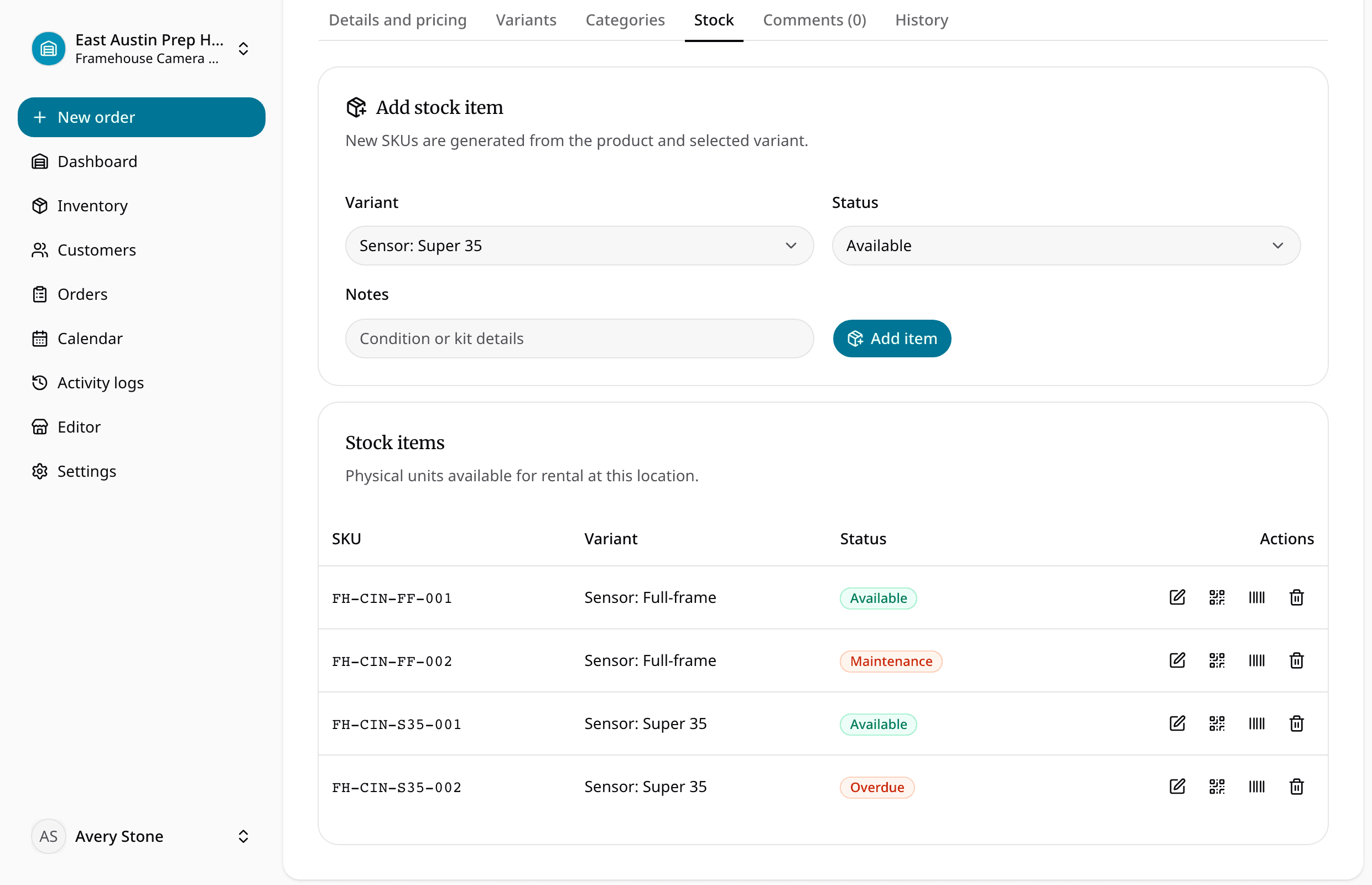
This test shows whether your planned operating process is clear before opening day. It does not demonstrate savings or profitability. To compare software requirements in more detail, use the equipment management software buyer's guide.
Run a sample reservation, checkout, and return in RentalBench.
Build your own equipment rental startup cost worksheet
Use a sheet with these columns:
| Field | What to record |
|---|---|
| Cost and purpose | Equipment unit, lease deposit, insurance, software, or another named expense |
| Evidence | Supplier quote, published fee, renewal notice, or clearly labeled estimate |
| Cash due before opening | Include deposits, purchase taxes, freight, and setup where applicable |
| Recurring amount and timing | Monthly bill, annual prepayment, transaction fee, or loan schedule |
| Included elsewhere? | Prevent counting prepaid expenses or deposits twice |
| Contingency and owner | Uncertainty to cover and who will confirm the figure |
Then calculate:
starting cash = pre-opening cash payments + contingency + operating reserve
Keep a separate list of existing assets and their ongoing costs. Replace estimates with dated quotes, test a slower booking ramp, and identify which purchases can wait until demand supports them. For the broader launch sequence, read how to start and run a rental business.
Equipment rental startup cost FAQ
Can I start an equipment rental business for under $10,000?
Possibly, if you already own suitable inventory and space and choose a narrow operation. That does not make insurance, maintenance, administration, or working capital free. List what is already paid for, what is due before opening, and the monthly cash gap. A small equipment purchase budget alone cannot establish launch affordability.
What is the biggest startup expense?
Equipment acquisition is the largest pre-opening line in each example here. Your largest cash payment could differ if you finance equipment, buy property, or need substantial site work. Compare the full acquisition cost, opening payment, and ongoing commitments separately so a low down payment does not hide the size of the obligation.
Should I count customer security deposits as startup funding?
Do not treat refundable customer deposits as earned rental income in the cash plan. They may need to be returned, and their treatment depends on your terms and local requirements. Track them against the relevant rental and keep enough cash to meet refund obligations; confirm the accounting treatment with your accountant.
Cost the business before buying the fleet
The cost to start an equipment rental business comes from a specific fleet and operating plan. Use the example budgets to identify missing costs, then replace every assumption with evidence for your location. Keep acquisition costs, financing payments, and cash reserves distinct, and test the rental workflow before taking on live orders.
Review the trial terms on the RentalBench pricing page. The 14-day Plus trial requires a card. Start monthly billing begins afterward unless you choose another plan or cancel through billing.
About Ciprian Redinciuc
Ciprian Redinciuc writes RentalBench product and rental operations guides based on the workflows implemented in RentalBench: inventory, availability, orders, storefront intake, deposits, checkout, and returns.